

When choosing custom carpentry, the material inside the cabinet matters just as much as the colour, layout and external finish.
At Picket & Rail, we do not believe there is one single material that is automatically the best choice for every home or every application.
Different materials serve different purposes.
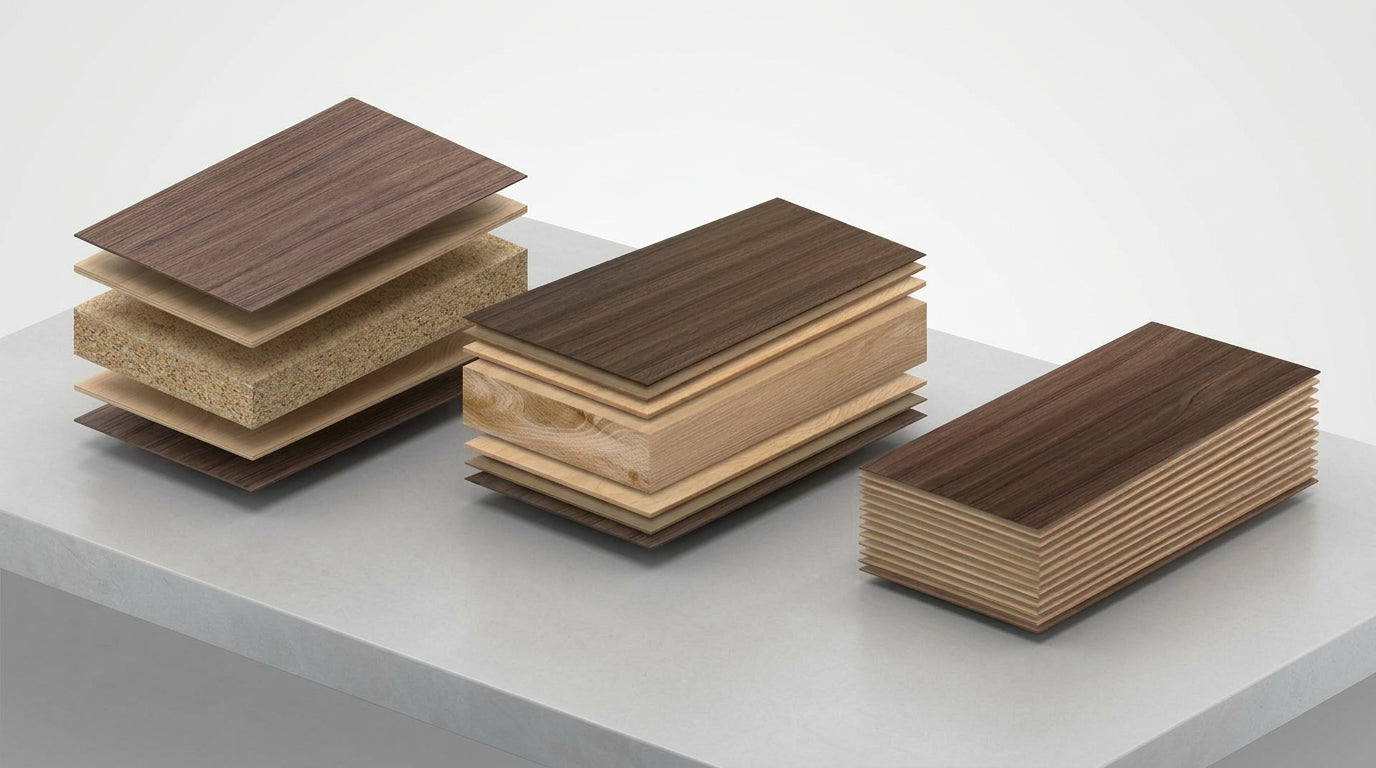
That is why our cabinetry can be built using three different construction materials:
- Performance Engineered Wood
- Solid Plywood
- Solid Wood Core
Each offers a different balance of design flexibility, construction preference, material composition and budget.
Rather than arranging them as good, better and best, we help customers choose the material that makes the most sense for the way their furniture will be designed and used.
1. Performance Engineered Wood
Purpose-Built for Modern Cabinetry
Performance Engineered Wood is our most versatile cabinetry material.
It is manufactured from processed timber that is formed and compressed under controlled production conditions to create a highly consistent panel.
Unlike the common perception that all particle-based boards are simply made from low-grade leftover wood, our material is purpose-built as a furniture and cabinetry panel.
Its controlled construction gives it an important advantage:consistency.
For modern cabinetry, where multiple doors, shelves, drawers and structural panels need to fit together accurately, dimensional consistency is extremely useful.

Why Choose Performance Engineered Wood?
It is particularly suited to customers looking for:
- Extensive colour and finish choices
- Consistent panel construction
- Precision machining
- Flexible furniture design
- Good cost efficiency
Multiple panel thicknesses for different applications.Performance Engineered Wood is available in:
18mm · 25mm · 35mm
The availability of thicker 25mm and 35mm panels gives our designers greater flexibility when creating furniture components that require a more substantial visual proportion or different structural characteristics.
This makes it particularly versatile across wardrobes, kitchens, Tatami storage beds and other custom cabinetry applications.
Engineered for Consistency
Performance Engineered Wood should not simply be viewed as a lower-cost substitute for plywood or solid timber.
Its role is different.
Modern furniture production increasingly depends on predictable dimensions, precision cutting, accurate drilling and consistent surfaces.
A purpose-manufactured engineered panel works particularly well in this environment while supporting a broad range of decorative finishes.
For customers who prioritise design flexibility, consistency and value, Performance Engineered Wood can therefore be a very practical choice.
2. Solid Plywood
For Those Who Prefer Traditional Layered Wood Construction
Solid Plywood is our customer-facing term for a traditional multi-layer plywood construction.
It is built from multiple layers of wood veneer bonded together to form a structural panel.
Plywood has been used in furniture and carpentry for generations and remains a familiar choice among homeowners.
Many customers already understand plywood and specifically request it when planning custom carpentry.
At Picket & Rail, we therefore offer Solid Plywood as a distinct construction choice rather than positioning it as an automatic upgrade from engineered wood.

Why Choose Solid Plywood?
It may appeal particularly to customers who prefer:
- Traditional plywood construction
- Multiple bonded wood layers
- A familiar carpentry material
- A conventional wood-based panel system
- The layered structure commonly associated with plywood
Solid Plywood is available in:
18mm · 25mm
These thicknesses cover the principal requirements of most cabinetry components while retaining the familiar layered construction associated with plywood.
Solid Plywood Is a Preference, Not a Ranking
Cabinet materials are often presented in a simple hierarchy:
Particle board → Plywood → Solid wood.
We believe that oversimplifies the decision.
Different materials offer different characteristics and are suited to different design requirements.
For example, a customer looking for maximum colour choice and a wide variety of panel thicknesses may have very different priorities from a customer who specifically prefers plywood construction.
The material should therefore be selected according to the project rather than simply according to perception.
3. Solid Wood Core
For Those Who Prefer More Natural Timber Within Their Cabinetry
Solid Wood Core is our latest cabinetry material option.
Its central structure is formed from joined solid timber strips or planks, with plywood layers applied to both sides.
The result combines a substantial solid timber core with an engineered panel construction suitable for cabinetry.
This provides another option for customers who want more natural timber within the internal structure of their furniture.

Why Choose Solid Wood Core?
It may be particularly appealing to customers looking for:
- A genuine solid timber core
- Greater natural timber content
- An alternative to conventional engineered wood panels
- A timber-based panel developed specifically for cabinetry
Solid Wood Core is available in:
18mm · 25mm
The plywood layers on both faces help create a balanced panel construction while allowing the solid timber centre to remain the defining feature of the material.
Solid Wood at the Core
The defining characteristic is simple:
There is solid timber at the heart of the panel.
For customers who place importance on natural material content, Solid Wood Core provides a different construction choice without requiring the furniture to be built entirely from traditional solid timber boards.
Is Solid Wood Core the Same as Solid Wood Furniture?
No.
This is an important distinction.
Traditional solid wood furniture is generally constructed directly from solid timber components.
Examples include solid wood bed frames, chairs or dining tables where the individual structural pieces themselves are made from solid timber.
Solid Wood Core cabinetry uses a different construction method.
The central section of the panel is solid timber, while plywood layers are applied to both sides.
It is therefore more accurately described as aSolid Wood Core panel rather than a traditional solid wood plank.
This construction is designed specifically for panel-based furniture and cabinetry.
Comparing the Three Materials
| Material | Main Purpose | Available Thickness |
|---|---|---|
| Performance Engineered Wood | Maximum versatility, consistency and finish choice | 18mm, 25mm, 35mm |
| Solid Plywood | Traditional layered wood construction | 18mm, 25mm |
| Solid Wood Core | More natural timber within the cabinet structure | 18mm, 25mm |
The thickness options should not be interpreted as a quality ranking.
Different thicknesses allow our designers to select proportions and constructions appropriate for different furniture components.
For example, a thicker panel may be selected for a particular visual treatment, structural requirement or furniture detail, while a standard 18mm panel may remain entirely appropriate elsewhere.
So Which Material Should You Choose?
There is no universal answer.
The right choice depends on what matters most to you.
Choose Performance Engineered Wood if:
You want maximum flexibility in colour, finish, panel thickness and furniture design, together with consistent panel construction and good overall value.
Choose Solid Plywood if:
You specifically prefer the familiarity and structure of traditional multi-layer plywood cabinetry.
Choose Solid Wood Core if:
You prefer a cabinetry panel containing substantially more natural timber while retaining a panel construction designed for modern carpentry.
Rather than asking which material is simply “best”, a more useful question is:
Which material best suits the way your furniture will be designed, finished and used?
Different Materials. One Construction Philosophy.
The material itself is only one part of good cabinetry.
The final result also depends on:
- Furniture design
- Panel cutting accuracy
- Edge finishing
- Hardware selection
- Manufacturing consistency
- Installation quality
- Practical storage planning
At Picket & Rail, our approach is to combine the appropriate material with precision manufacturing and thoughtful furniture design.
This construction philosophy is applied across our custom carpentry range, including:
- Kitchen cabinets
- Wardrobes
- Tatami storage beds
- Built-in storage
- Custom furniture
- Whole-home carpentry projects
Instead of forcing every customer into one material specification, we provide different construction options for different priorities.
Because the most appropriate material is ultimately the one that makes sense for the furniture being built.
Frequently Asked Questions
What are the three cabinetry materials available at Picket & Rail?
We offer three main cabinetry materials: Performance Engineered Wood, Solid Plywood and Solid Wood Core. Each is designed for different priorities rather than being arranged as a simple good, better and best hierarchy.
What is Performance Engineered Wood?
Performance Engineered Wood is a purpose-built cabinetry panel made from timber that is processed into smaller particles and compressed under controlled manufacturing conditions. Its consistent structure makes it particularly suitable for precision machining, customised cabinetry and a wide selection of decorative finishes.
Is Performance Engineered Wood the same as conventional particle board?
It belongs to the engineered wood panel family, but our Performance Engineered Wood is purpose-manufactured for furniture and cabinetry. Its key advantages are consistency, precision, design flexibility and the availability of different panel thicknesses.
What is Solid Plywood?
Solid Plywood is our term for traditional multi-layer plywood construction. It is made from multiple bonded wood veneer layers and is suited to customers who prefer the familiar layered structure traditionally associated with plywood cabinetry.
Is Solid Plywood better than Performance Engineered Wood?
Not necessarily. The two materials serve different purposes. Performance Engineered Wood provides excellent consistency, extensive finish choices and greater thickness flexibility, while Solid Plywood appeals to customers who prefer traditional layered plywood construction.
What is Solid Wood Core?
Solid Wood Core is a cabinetry panel built around joined solid timber strips or planks, with plywood layers applied to both faces. It is designed for customers who prefer more natural timber within the internal structure of their cabinetry.
Is Solid Wood Core the same as traditional solid wood furniture?
No. Traditional solid wood furniture is generally constructed directly from solid timber components. Solid Wood Core uses solid timber within the centre of the panel together with plywood layers on both sides, making it a different construction specifically suited to panel-based furniture and cabinetry.
What panel thicknesses are available?
Performance Engineered Wood is available in 18mm, 25mm and 35mm. Solid Plywood and Solid Wood Core are available in 18mm and 25mm. The appropriate thickness is selected according to the furniture design and intended application.
Which material offers the most design flexibility?
Performance Engineered Wood generally offers the greatest flexibility in colours, finishes and panel thicknesses. This makes it particularly useful for highly customised kitchens, wardrobes, Tatami storage beds and other built-in furniture.
Why does Picket & Rail offer three different cabinetry materials?
Different customers have different priorities. Some value maximum colour and design flexibility, some prefer traditional plywood construction, while others prefer more natural timber within the panel. Offering all three allows the material to be selected according to the project rather than forcing every customer into one construction method.
Which material is best for kitchen cabinets, wardrobes or Tatami storage beds?
All three materials can be suitable depending on the design, application, finish preference and budget. Rather than selecting a material based only on perception, we recommend considering the complete furniture system, including panel construction, thickness, hardware, manufacturing precision and installation.
Is one material considered the premium option?
We do not position our materials as good, better and best. Performance Engineered Wood, Solid Plywood and Solid Wood Core each have different characteristics and advantages. The most appropriate material is the one that best matches the design and priorities of the individual project.