


When buying wooden furniture, most people naturally ask:
Is it solid wood? What species is it? Is it durable? How long will it last?
These are important questions. But there is another one that deserves just as much attention:
Where did the timber come from, and how responsibly was it sourced?
We recently had the opportunity to attend theGlobal Legal & Sustainable Timber Forum 2026 in Macao, where participants across the timber and furniture industries discussed responsible sourcing, timber legality, traceability, manufacturing and the future of sustainable wood.
For us, one idea stood out clearly:
Sustainable furniture starts long before the furniture is made.

What Makes Wood Furniture Sustainable?
Sustainability in furniture is not determined by a single label.
A piece of furniture may be made from solid wood, plywood or engineered wood, but the material itself only tells part of the story.
A more complete assessment should consider:
-
where the material originates
-
whether the timber was legally and responsibly harvested
-
how efficiently the material is processed
-
how much waste is generated during manufacturing
-
how durable the finished furniture is
-
whether it can be repaired or maintained
-
how long it is likely to remain useful
In other words, sustainability should be considered across theentire life of the furniture, rather than simply by looking at the material specification.
Responsible Timber Starts at the Source
Before a dining table, chair or bed reaches a home, its timber may already have travelled through a long supply chain.
It can involve forestry, harvesting, processing, trading, transportation and manufacturing across several countries.
This is why responsible sourcing matters.
Knowing the species of wood is useful, but increasingly, the timber industry is also paying attention to issues such as:
Legal harvesting. Responsible forest management. Traceability. Supply-chain transparency.
These considerations help provide a clearer understanding of where timber comes from and how it reaches the finished product.
For consumers, this means the words“solid wood” alone do not necessarily tell the whole story.
Is Solid Wood Always More Sustainable?
Not necessarily.
Solid wood has many advantages.
When appropriately selected and well constructed, solid timber furniture can be exceptionally durable and may remain in use for decades.
That longevity can make it a very sensible material for products such as beds, dining tables, chairs and other heavily used furniture.
But being solid wood does not automatically make a product sustainable.
The environmental impact also depends on factors such as:
-
timber source
-
species
-
forestry practices
-
transportation
-
manufacturing efficiency
-
amount of material used
-
product lifespan
A poorly designed solid wood product that is quickly discarded may ultimately be less sustainable than a carefully engineered piece that remains useful for many years.
The better question is therefore not simply:
“Is this solid wood?”
It is:
“Has the material been responsibly selected and appropriately used?”

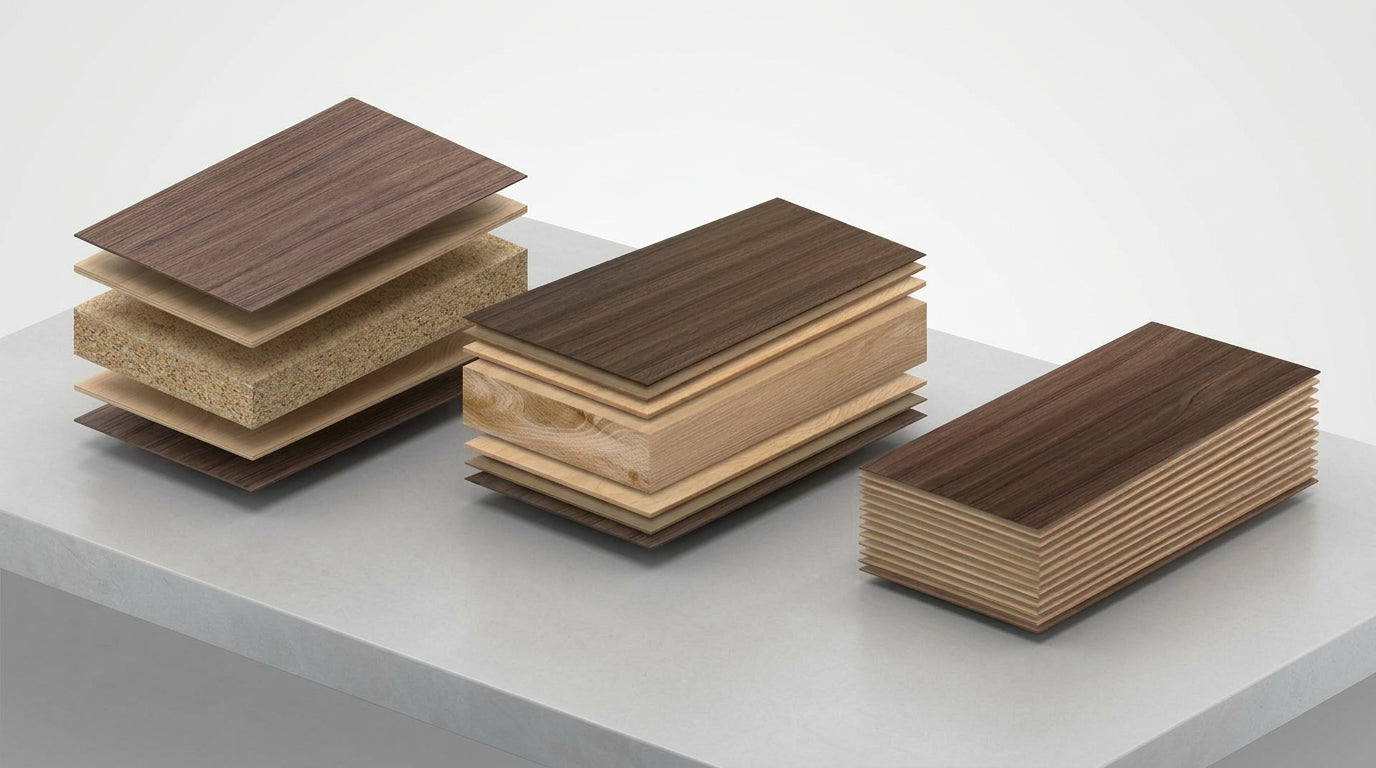
Solid Wood, Plywood or Engineered Wood: Which Is Better?
There is no single material that is automatically best for every type of furniture.
Each has different strengths.
Solid Wood
Solid timber works particularly well where structural strength, natural character and long service life are important.
It is commonly suited to products such as beds, dining tables and chairs.
Its natural grain and ability to age over time are also part of its appeal.
Plywood
Plywood is manufactured by bonding multiple layers of wood veneer together.
Its layered construction provides good dimensional stability and allows timber to be used efficiently.
Depending on its specification, plywood can be particularly useful in cabinetry, furniture structures and applications where strength is required without relying on thick sections of solid timber.
Engineered Wood
Modern engineered boards can provide excellent stability, manufacturing precision and material efficiency.
They are especially suitable for products such as:
-
kitchen cabinets
-
wardrobes
-
storage systems
-
built-in furniture
-
custom carpentry
Because these materials are manufactured to consistent dimensions, they also work particularly well with precision digital manufacturing.
The important point is that these materials should not necessarily be viewed as competing with one another.
They aredifferent materials for different applications.
Good furniture design begins by selecting the most suitable material for the job.
Sustainable Furniture Is Also Furniture That Lasts
Responsible sourcing is only the beginning.
Furniture also needs to perform well over time.
There is little environmental benefit in using responsibly sourced material if the finished product is poorly constructed or needs to be replaced after only a few years.
Longevity remains one of the most practical forms of sustainability.
Furniture that continues serving its purpose for ten, fifteen or twenty years naturally reduces the need for repeated manufacturing, transportation and replacement.
This is why good furniture design should consider more than appearance.
It should also consider:
Structure. Durability. Repairability. Adaptability. Long-term usefulness.
A product that remains relevant and functional for many years is inherently more resource-efficient than one designed around short-term trends.
More Material Does Not Always Mean Better Furniture
There is sometimes an assumption that heavier furniture or thicker pieces of timber automatically indicate better quality.
That is not necessarily the case.
Good furniture design is about using material intelligently.
Material should be placed where it contributes to:
-
structural strength
-
stability
-
function
-
comfort
-
appearance
Using unnecessary material can increase weight, cost and resource consumption without significantly improving the finished product.
Modern production methods increasingly allow designers to optimise how materials are used.
Digital cutting, precision machining and computer-assisted production can improve yield from boards and timber while reducing unnecessary waste.
This makesmaterial efficiency another important part of sustainable furniture design.

From Forest to Furniture
The discussions around sustainable timber increasingly connect several industries that were once viewed separately.
Forestry affects material availability.
Material science affects how timber can be used.
Manufacturing technology determines how efficiently it can be processed.
Furniture design determines how long the final product remains useful.
These relationships can be summarised in four words:
Source. Material. Manufacturing. Design.
Each influences the next.
A responsibly sourced material still needs to be manufactured intelligently.
Efficient manufacturing still requires good design.
And even beautifully designed furniture ultimately depends on appropriate material selection.
What Should Consumers Look For When Buying Wooden Furniture?
Rather than focusing on only one claim, consumers can ask several simple questions.
What material is being used?
Solid wood, plywood and engineered wood each have different characteristics.
Why was that particular material selected?
The material should make sense for the furniture's intended purpose.
How durable is the construction?
A well-designed structure can be as important as the material itself.
How long is the furniture expected to remain useful?
Longevity should be considered part of sustainability.
Can the manufacturer explain where its materials come from?
Greater transparency throughout the supply chain helps customers make more informed decisions.
Better Furniture Begins With Better Material Decisions
Sustainability should not simply be a marketing label placed on a finished product.
Ideally, it should influence decisions made much earlier.
Where did the material originate?
Is it appropriate for the application?
Can it be manufactured efficiently?
Can the finished product remain useful for many years?
These are increasingly important questions for both furniture makers and furniture buyers.
And as the industry develops, understanding the journeyfrom forest to furniture may become just as important as understanding the finished product itself.