

Alexander Calder’s art brings movement, balance and playfulness into an interior.
Although widely recognised for sculpture and mobiles, Calder also created graphic works built from confident lines, simplified forms and strong colour relationships. His encounter with Piet Mondrian’s studio in 1930 contributed to his shift toward abstraction.
These qualities make Calder especially compatible with contemporary furniture and interiors influenced by modernism or Bauhaus design.

Allow the Art to Supply the Movement
Modern interiors often contain straight architectural lines:
- rectangular sofas;
- linear cabinetry;
- flat wall panels;
- structured dining tables; and
- geometric room layouts.
Calder’s floating shapes and energetic lines soften this rigidity. The artwork introduces a sense of movement without requiring additional decorative clutter.
Use Primary Colours in Small Amounts
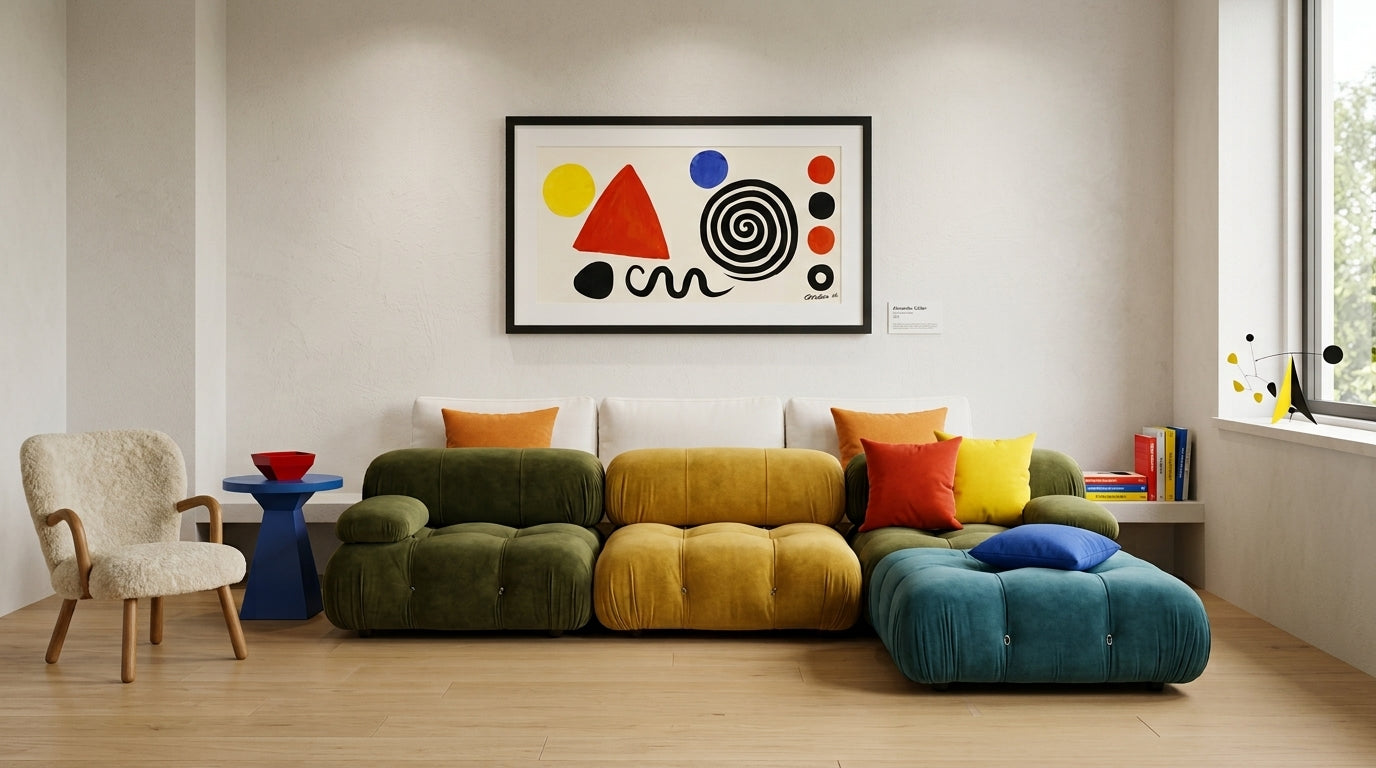
Calder’s works may contain red, yellow, blue and black.
You do not need to repeat every colour across the room. Choose one as a controlled accent.
For example:
- a red lounge chair;
- a yellow cushion;
- a blue side table;
- a black-framed lamp; or
- a small sculptural object.
Keep the largest furniture pieces relatively restrained so the artwork remains the visual focus.
Pair with Contemporary Furniture
Calder works especially well with furniture that has:
- slender legs;
- modular forms;
- geometric silhouettes;
- curved accent pieces;
- visible negative space; and
- strong but uncomplicated profiles.
A low modular sofa or sculptural lounge chair can echo the artwork’s modern character without imitating it directly.
Use Black as a Connecting Element
Black lines often provide structure within abstract art.
Repeating black through the frame, sofa feet, lighting or cabinet handles can connect the composition to the room.
This is particularly effective when the interior also contains natural wood. The wood adds warmth, while black provides definition.
Avoid Turning the Room into a Theme
A Calder artwork does not require every object to be brightly coloured or overtly “Bauhaus”.
One or two references are enough. Too many primary-coloured objects can reduce the sophistication of the setting and compete with the artwork.
Let the art be expressive. Let the furniture establish calmness and function.
The Ideal Placement
Calder’s graphic abstraction can work well:
- above a contemporary sofa;
- beside a dining setting;
- above a low sideboard;
- in a home office;
- along a staircase landing; or
- within a modern entrance area.
Choose a position where the work can be viewed from a reasonable distance, allowing its shapes and visual balance to be read as one complete composition.
Add Movement to a Modern Interior
Explore licensed Alexander Calder art alongside Picket&Rail’s contemporary sofas, dining furniture and custom cabinetry.